
06.13.2026
OpenUSD Is Rewriting How Buildings Talk to Each Other
📅 December 17, 2025 — OpenUSD Core Specification 1.0 was officially released. This marks the historic pivot from "internal film industry tool" to "cross-industry open standard." For the AECO industry (Architecture, Engineering, Construction, and Operations), it's a collaboration framework with real potential to solve thirty years of BIM pain points.
1. The Old Story in Construction: Whoever Holds the Model Owns the Mess
In London, New York, Tokyo, or Taipei, any AEC project of meaningful scale involves a dozen disciplines — structure, MEP, interior, landscape. The architect hands off a clean model. By the time it reaches the structural engineer, half the attributes are gone. By the time it reaches MEP, nothing translates. On site, everyone gives up and goes back to paper drawings. This isn't a regional quirk — it's a thirty-year global affliction.
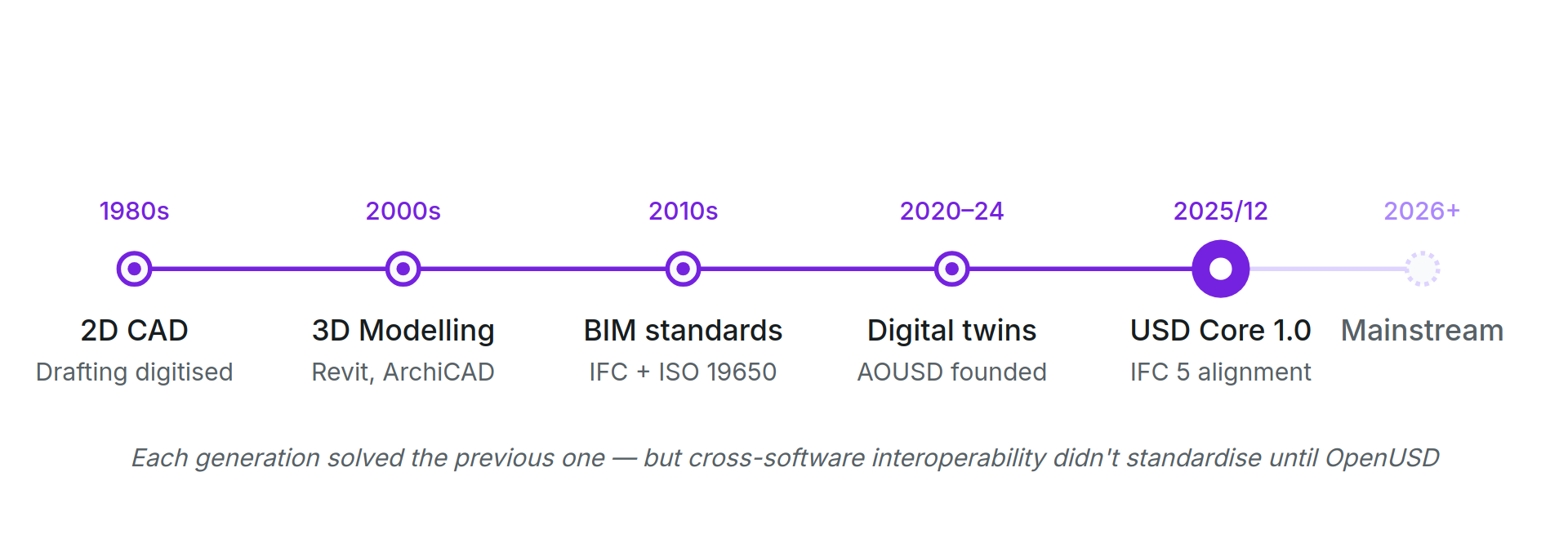
Figure 01 ・ Three Decades of Digital Collaboration in AEC (Timeline)
Anyone who's actually been through a multi-discipline coordination cycle will recognize this image immediately. The left side is the everyday reality of three decades of attribute loss; the right side is what OpenUSD offers as a new answer: it isn't yet another file format — it's a hub. It accepts IFC semantics, BIM properties, and CAD models on the input side, then extends downstream to rendering, AR/VR, real-time IoT data, AI simulation, and the bidirectional sync between the physical world and the digital twin.
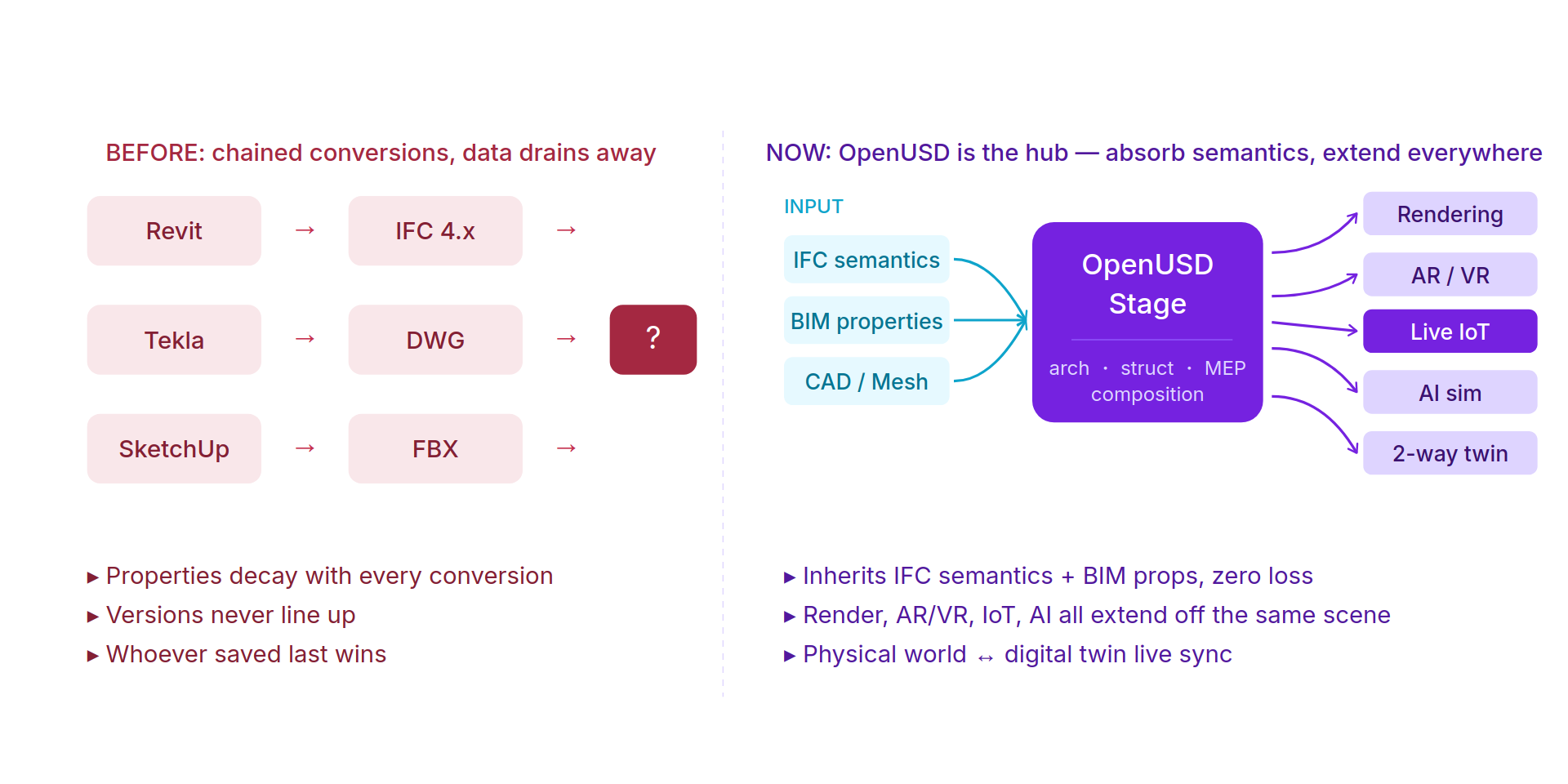
Figure 02 ・ OpenUSD as the Hub
OpenUSD started as Pixar's tool for managing 3D film scenes, was open-sourced in 2016, and in 2023, Pixar, Adobe, Apple, Autodesk, and NVIDIA jointly founded AOUSD. The film industry's solution is now officially preparing to rescue the construction industry.
2. Three Technical Concepts That Make USD More Than "Just Another Format"
2.1 LIVRPS: Non-Destructive Magic Across Seven Layers
USD's core isn't a file format — it's a composition framework. Seven composition arcs stack by strength: stronger layers override weaker ones, but never destroy what's underneath.
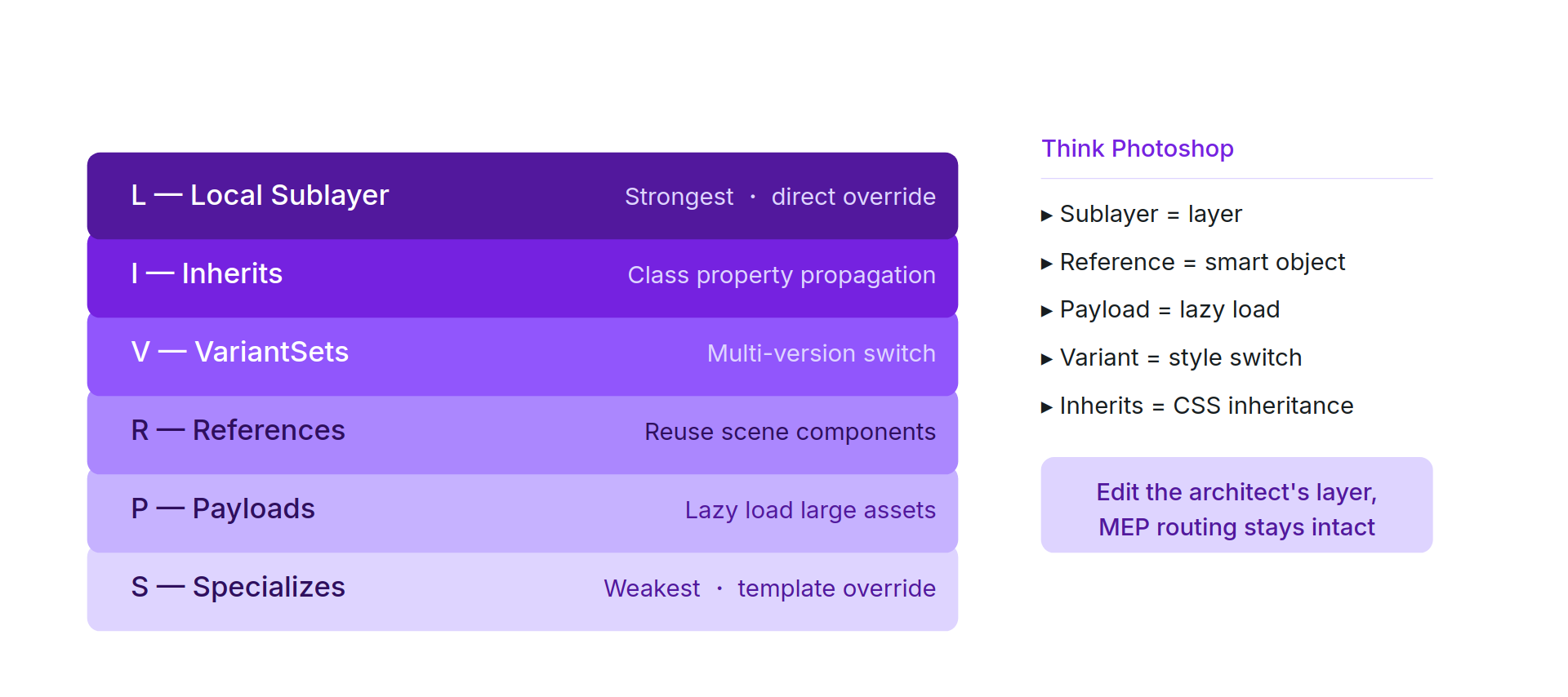
Figure 03 ・ LIVRPS — Seven Composition Arcs
2.2 Composition vs. Import
In traditional BIM, "import" means copying data. The moment the source file updates, your copy is stale. In USD, composition is always live reference. When the referenced file changes, every scene that uses it picks up the latest version on the next composition pass. This is exactly the capability that lets BMW's 20,000 planners and Foxconn's multi-site teams collaborate on a single Stage.
2.3 Hydra and USDZ
OpenUSD has another component that's often underestimated: Hydra. It separates scene data from render backend — the same USD scene can be fed to RenderMan, Arnold, V-Ray, or RTX. An HDMI analogy: the same laptop outputs 4K HDR to a TV and 1080p to a projector — same cable, different display. USDZ is the package format jointly designed by Pixar and Apple: a client taps a link on an iPhone and sees a 1:1 building model in their living room.
3. OpenUSD ≠ IFC — They're Partners, Not Competitors
The first question most people ask: if we already have IFC, why do we need OpenUSD?
The answer is this. IFC answers "what is this building" — semantics, properties, structured data, long-term archival. OpenUSD answers "what can you do with that data" — rendering, real-time collaboration, IoT integration, AI simulation, AR/VR experience, bidirectional twin. IFC is like a professional architectural dictionary; USD is the workspace you build after acquiring that dictionary. They aren't substitutes — they're a division of labor.
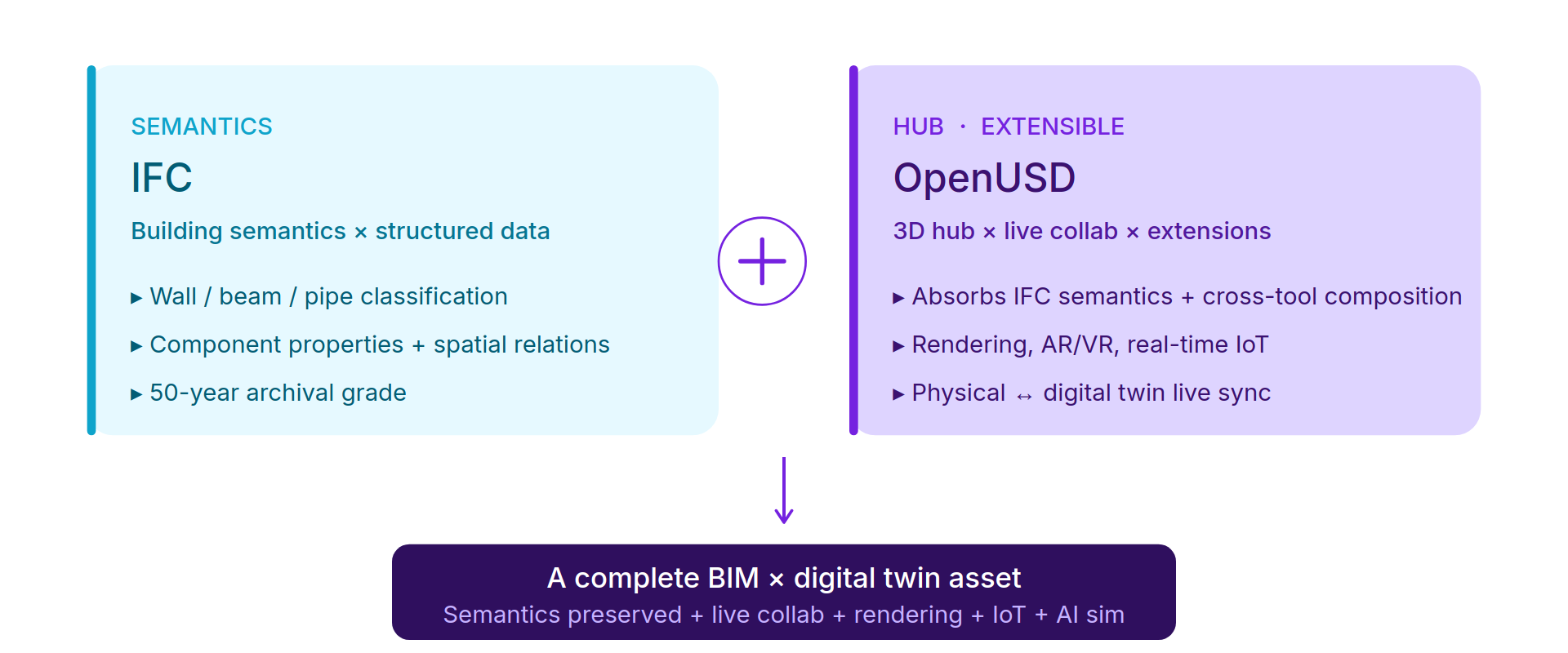
Figure 04 ・ IFC × OpenUSD Complementarity
Moving from the abstract to the concrete: write the same exterior wall as two files and the difference becomes visceral. The IFC version on the left says clearly "what this is." The USD version on the right inherits the same semantics in full, then carries four more things on top: rendering, physics, real-time IoT data, and per-discipline Layer collaboration.
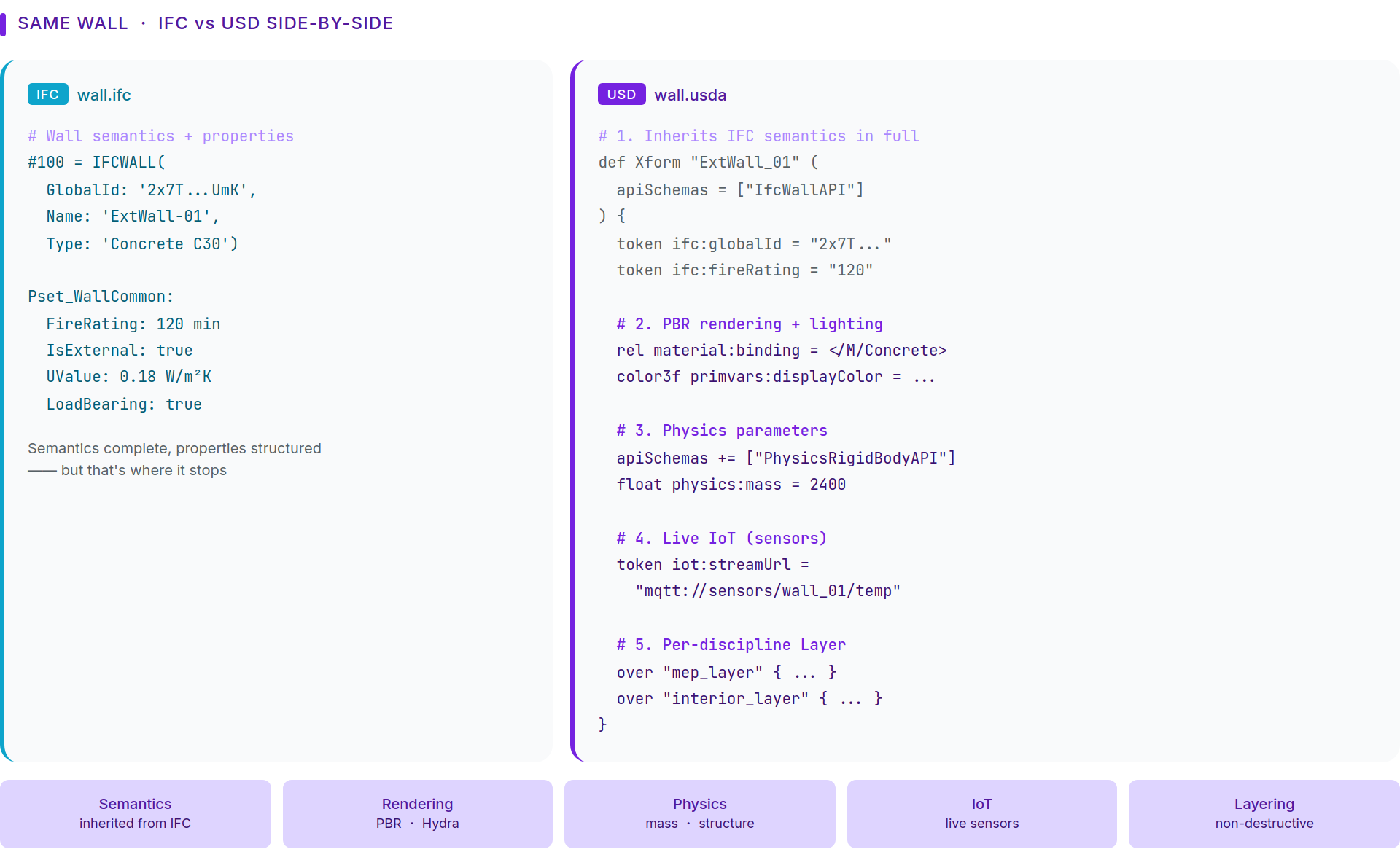
Figure 05 ・ IFC vs. USD Code Comparison
In other words: IFC writes "information," USD writes "information + behavior." An IFC wall can tell you its fire rating is 120 minutes. The same wall in USD also tells you how to render it in Omniverse, that it weighs 2,400 kg (and whether that crushes the structure below), the live reading from its temperature sensor, and that the MEP engineer is currently adding pipes in its internal Layer.
Within this "extension," rendering is the most immediately visible piece. USD describes PBR materials with UsdPreviewSurface and physical lighting with UsdLux — pulling architectural visualization up from BIM-output quality to film-grade.
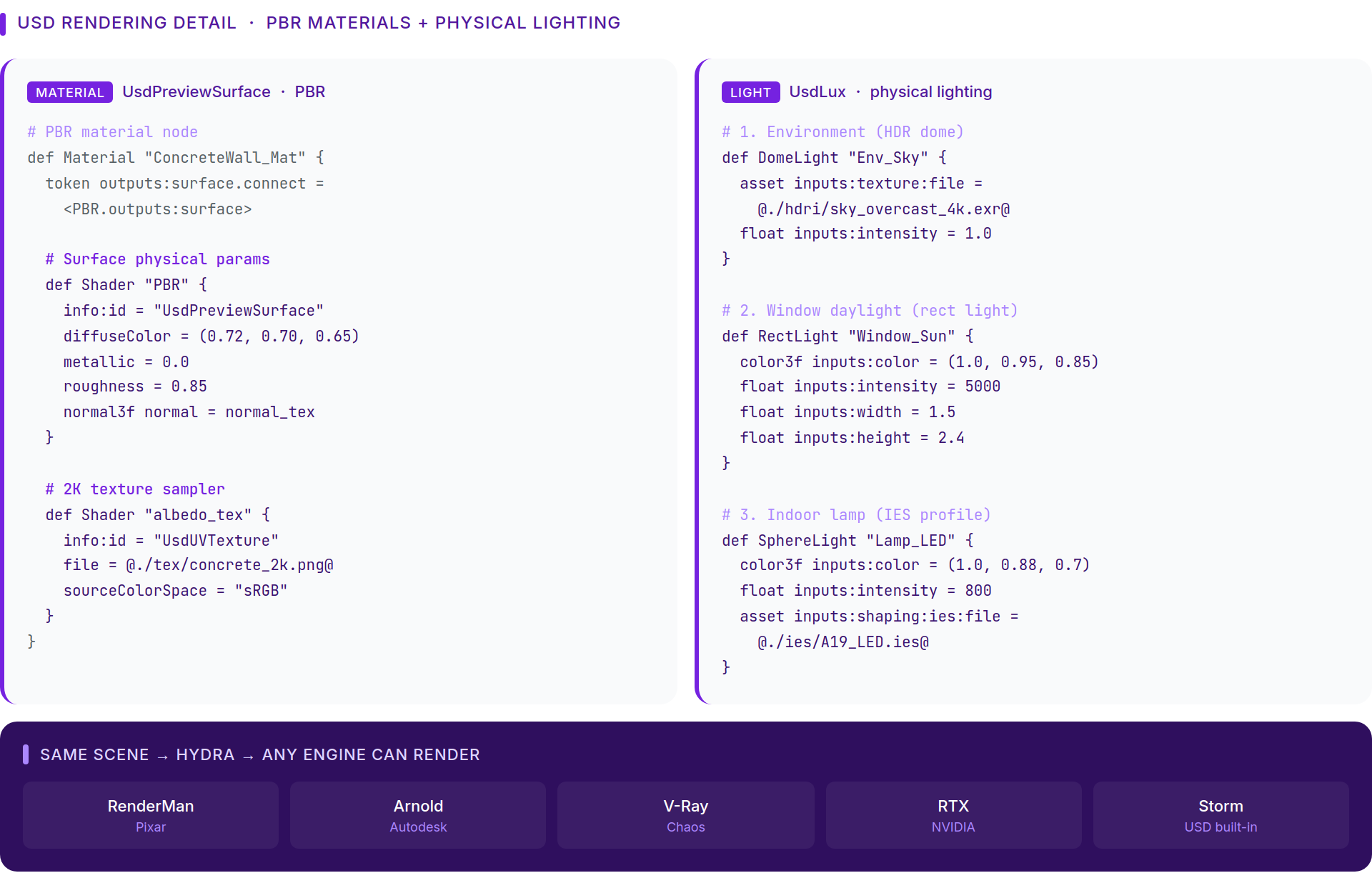
Figure 06 ・ USD PBR Material and Lighting Detail
Physics deserves the same kind of closer look. USD doesn't just give the architect pretty renders — it lets structural, CFD, and robotics engineers all run simulations against the same scene. One description, fed to different solvers:
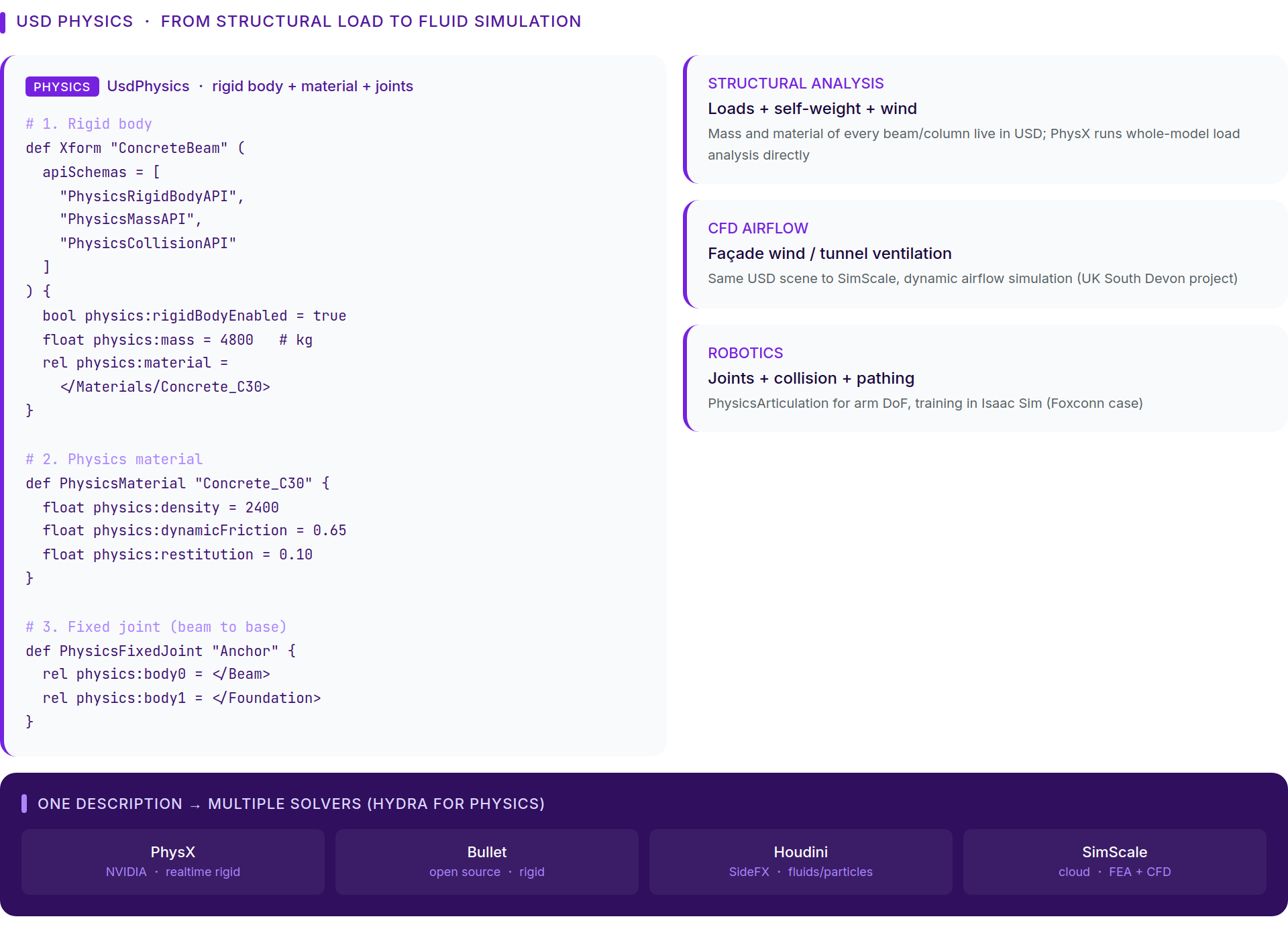
Figure 07 ・ USD Physics Example
The code on the left, just over twenty lines, is enough for PhysX to simulate a 4,800 kg concrete beam at C30 strength, fixed to its foundation, as a complete rigid body. The three applications on the right look unrelated — structural, CFD, robotics — but they're now reading the same USD scene. This is where "hub" gets its power: in the past, three teams built three models, each running its own solver. Now three teams share one model, each connecting to its own solver.
USD Physics also enables one of its most future-facing applications: AI training in Isaac Sim. Treat the USD scene as a robot's "virtual factory," run thousands of parallel simulations to produce synthetic data, train perception and control models, deploy to physical robots, then feed real-world data back to the USD scene for continuous improvement.
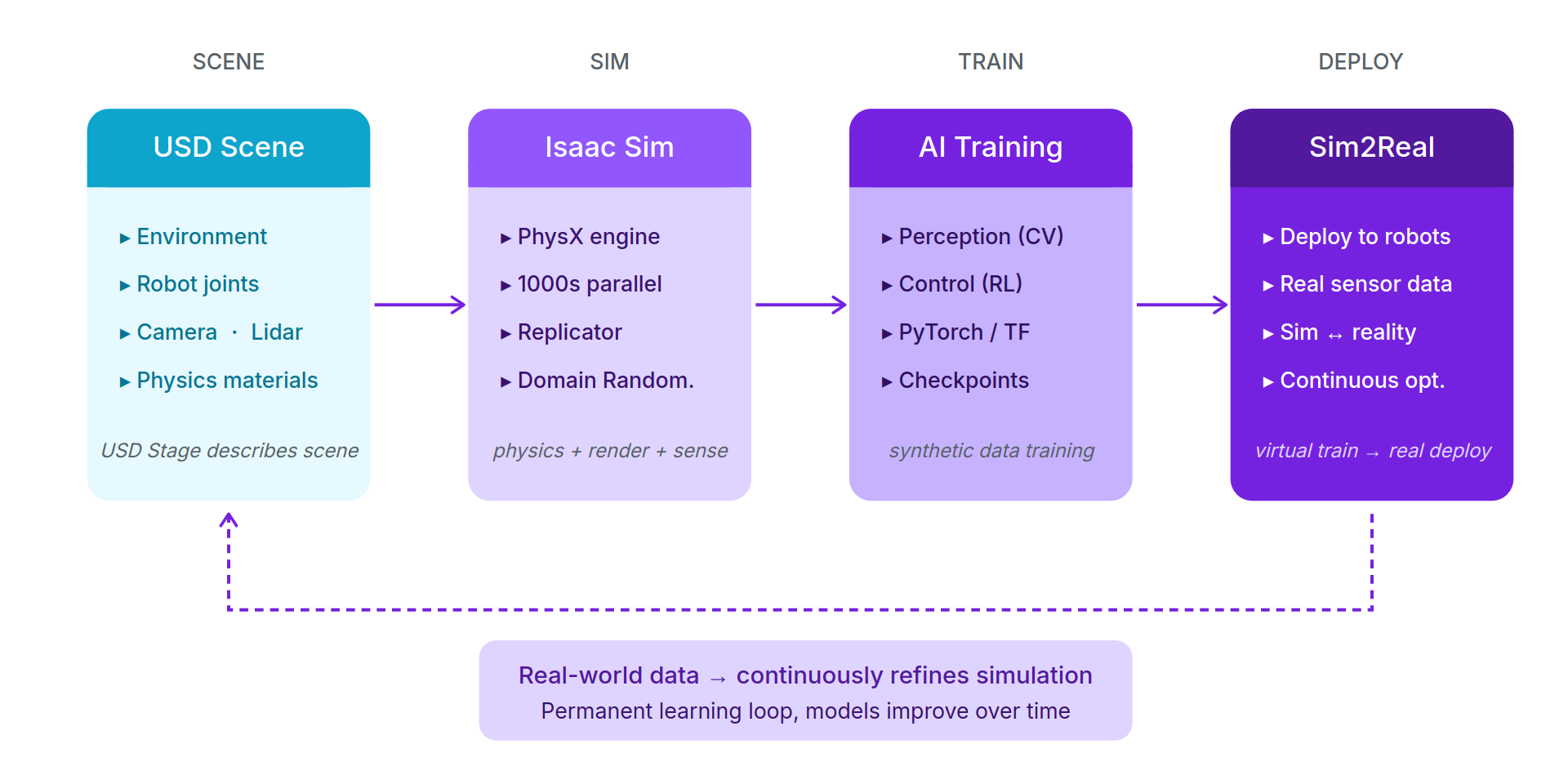
Figure 08 ・ USD ↔ Isaac Sim Training Loop
For AECO, this isn't just "that's neat." Foxconn's Houston facility uses this loop to train production-line robotic arms; Amazon trains warehouse AGVs the same way; Boston Dynamics trains inspection robots in Isaac Sim. All are in production. Translated to construction: describe a job site in USD today, and tomorrow you can train construction robots against the same scene. This is USD's bridge from "design tool" to "physical AI."
So, how exactly do IFC 5 and USD interoperate? It comes down to a four-stage pipeline:
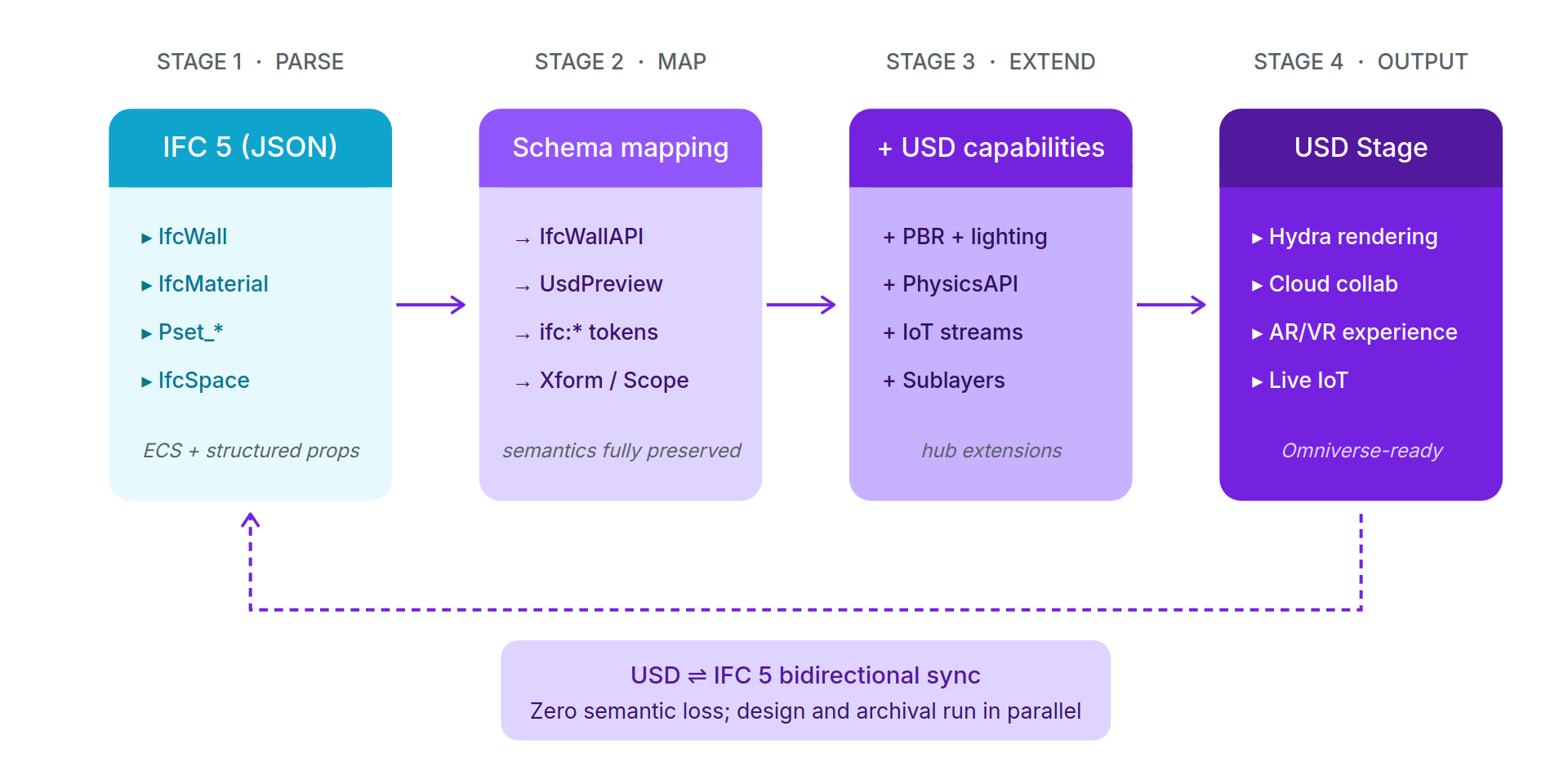
Figure 09 ・ IFC 5 → USD prim Four-Stage Pipeline
The most important part of this pipeline is the bidirectional dashed arrow at the end. A scene in USD Stage can be exported back to IFC 5 with semantics fully preserved. This means architecture firms don't have to pick a side. Continue producing IFC models in your familiar BIM tools during design; bring them into USD when you need real-time collaboration, cloud visualization, or AR/VR client experiences; and still deliver IFC 5 to the owner for archival — fully compliant.
On October 1, 2024, buildingSMART and AOUSD signed a liaison agreement in London. The forthcoming IFC 5 adopts a component-based (ECS) architecture, JSON serialization, and explicitly incorporates OpenUSD integration mechanisms — meaning future IFC 5 files can exist directly as USD prims, with semantics fully preserved while gaining USD's hub capabilities. This is also why Autodesk, Trimble, Bentley, and Hexagon — the BIM giants — don't see USD as a threat. They've all joined AOUSD. It's an upgrade, not a replacement.
4. 2025: The Year OpenUSD Crossed Into Every Industry
If 2023 was the year AOUSD was founded, and 2024 was the year the AECO Interest Group was launched, 2025 is the year it broke into every industry. AOUSD expanded from 30+ to 50 General + 88 Contributor members, spanning automotive, cloud, retail, energy, and consulting across the full value chain.
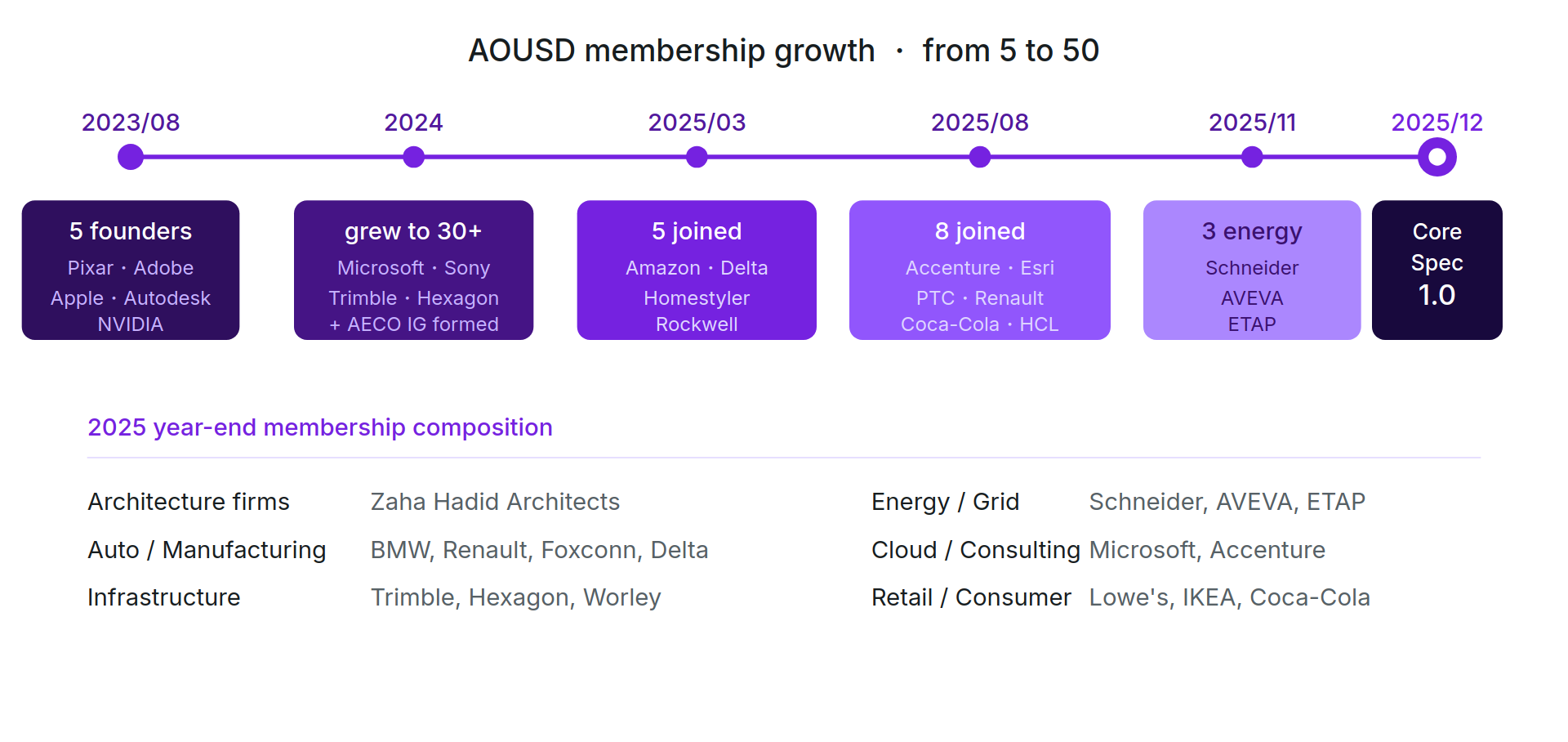
Figure 10 ・ AOUSD 2025 Membership Expansion Timeline
In November, Schneider Electric, AVEVA, and ETAP — three energy software giants — joined simultaneously, with the shared goal of using OpenUSD to design power and cooling digital twins for NVIDIA AI Factories. OpenUSD is no longer just an architecture story — it's becoming the common language for anything physical infrastructure touches.
4.1 Industrial Digital Twins

Figure 11 ・ Global Industrial OpenUSD Cases
BMW achieved a "virtual SOP" (Start of Production) at its Debrecen plant — two years ahead of physical production. The world's first factory to be fully validated and planned in simulation before any concrete was poured. Foxconn uses Omniverse in Houston to design the production lines for GB200 AI infrastructure.
4.2 Infrastructure
Infrastructure is adopting faster than typical architecture practice does, because the coordination complexity across MEP, civil, geotechnical, and structural is much higher — and USD's non-destructive composition hits exactly that pain point.
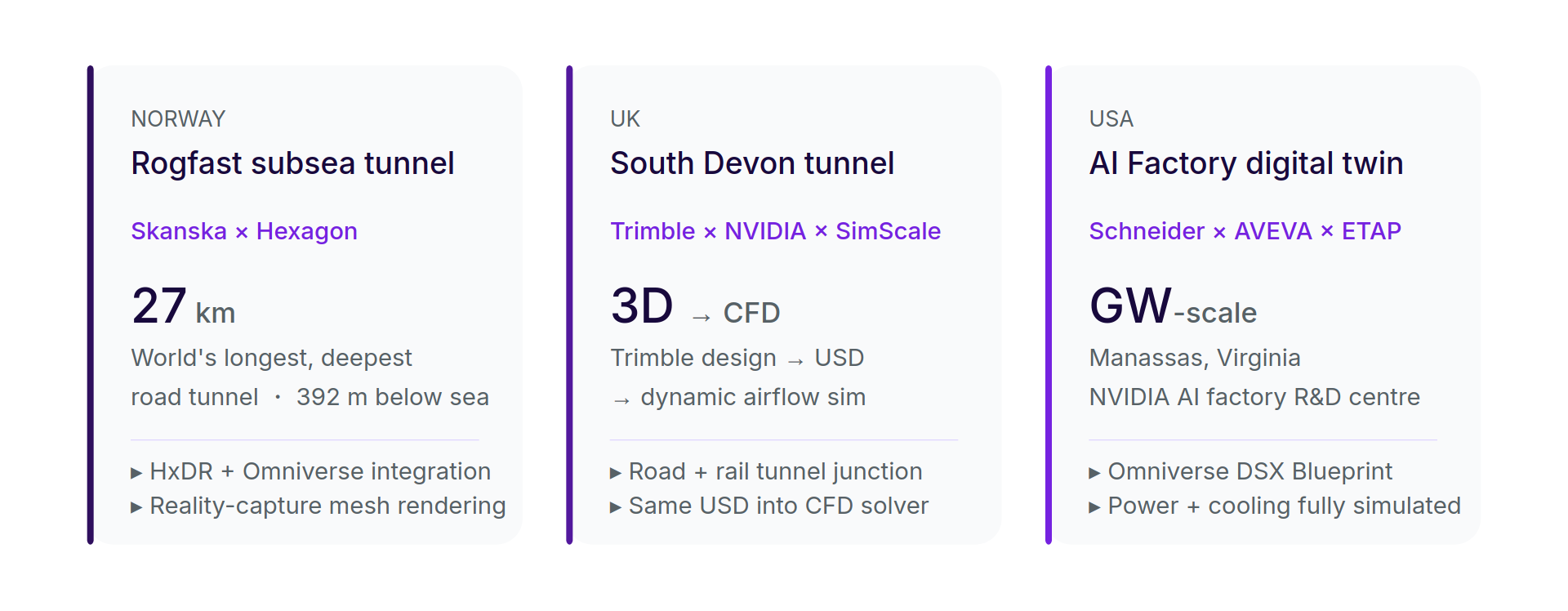
Figure 12 ・ Three Landmark Infrastructure Cases
The most strategically meaningful is the AI Factory digital twin. The data center is treated as a "breathing building" — the USD scene wires up power, cooling, and live IoT sensors. This is the "hub" concept made operational.
4.3 Software, Cloud, and Retail Life
In August 2025, Microsoft and NVIDIA jointly published the Composable Bindings whitepaper at Ignite, demonstrating how OpenUSD + CloudEvents + OpenTelemetry can wire up scalable digital twins.
- Esri joining means GIS now flows into USD;
- PTC brings PLM integration;
- Accenture and HCLTech joining means the world's top-10 consulting firms are placing OpenUSD at the core of enterprise digital transformation.
- On the retail side, Lowe's open-sourced 500+ USDZ assets, while IKEA and Coca-Cola are bringing brand visual assets into the USD ecosystem.
OpenUSD is becoming the broadest common language between the physical and the virtual.
5. Asia and Taiwan Highlights
Asia has been slower to adopt, but 2025 brought breakthroughs. Japan's Rikei launched "JAPAN USD Factory." Singapore's Virtual Singapore integrates over 10 government data layers.
🇹🇼 Taiwan Highlight ・ Delta Electronics
In March 2025, Delta Electronics joined AOUSD — the first Taiwanese company in the alliance. Their flagship DIATwin platform uses Omniverse + USD + Isaac Sim to integrate electronics production lines. TSMC, Foxconn, and Wistron have all appeared in GTC keynotes. But pure-play architecture-industry public cases are still scarce. For Taiwanese architecture firms, contractors, and the public sector, 2026 is a strategic window of opportunity.
6. Reality Check and Adoption Guide
OpenUSD isn't a silver bullet. Architectural semantic schemas are still evolving, the learning curve is steep, and large-scale collaboration demands GPU and network capacity. But the first question on most readers' minds isn't any of that — it's: "I'm using Revit / Rhino / SketchUp — how do I start?"
The answer is surprisingly simple. Mainstream tools don't need to be replaced — Omniverse Connector lets them plug in live:
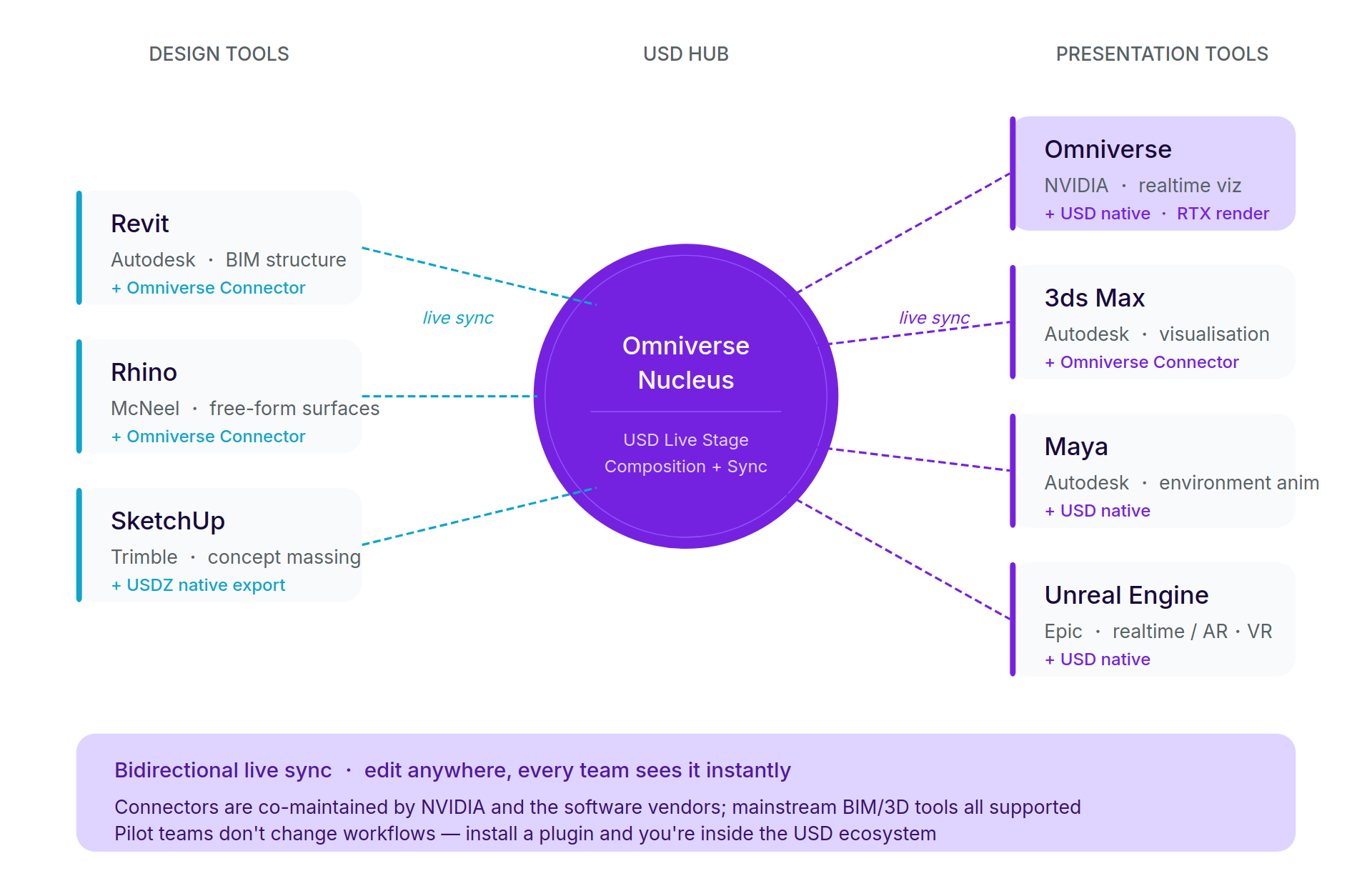
Figure 13 ・ Omniverse Connector × DCC Workflow
The key message in this image is that the dashed connections are bidirectional. It isn't a one-way "Revit export → USD" pipeline. Edit a wall in Revit, and the SketchUp massing reflects it instantly, the 3ds Max render scene re-bakes in sync, and the Unreal AR/VR experience updates in real time. This is exactly how Zaha Hadid Architects (ZHA) saves a week per iteration.
In practice, Connectors fall into two categories:
(1) Connector plugins — Revit, Rhino, 3ds Max, SketchUp, Maya, Houdini all have official Omniverse plugins; install and read/write USD live.
(2) Native USD support — NVIDIA Omniverse, Maya 2022+, Unreal 5.x+, and Blender 4.x+ ship with USD readers/writers built in; no Connector needed. In other words, for most firms the threshold is "download a plugin," not "switch to a new tool."
But connecting your toolchain isn't the end of the story. The pragmatic strategy is staged adoption:
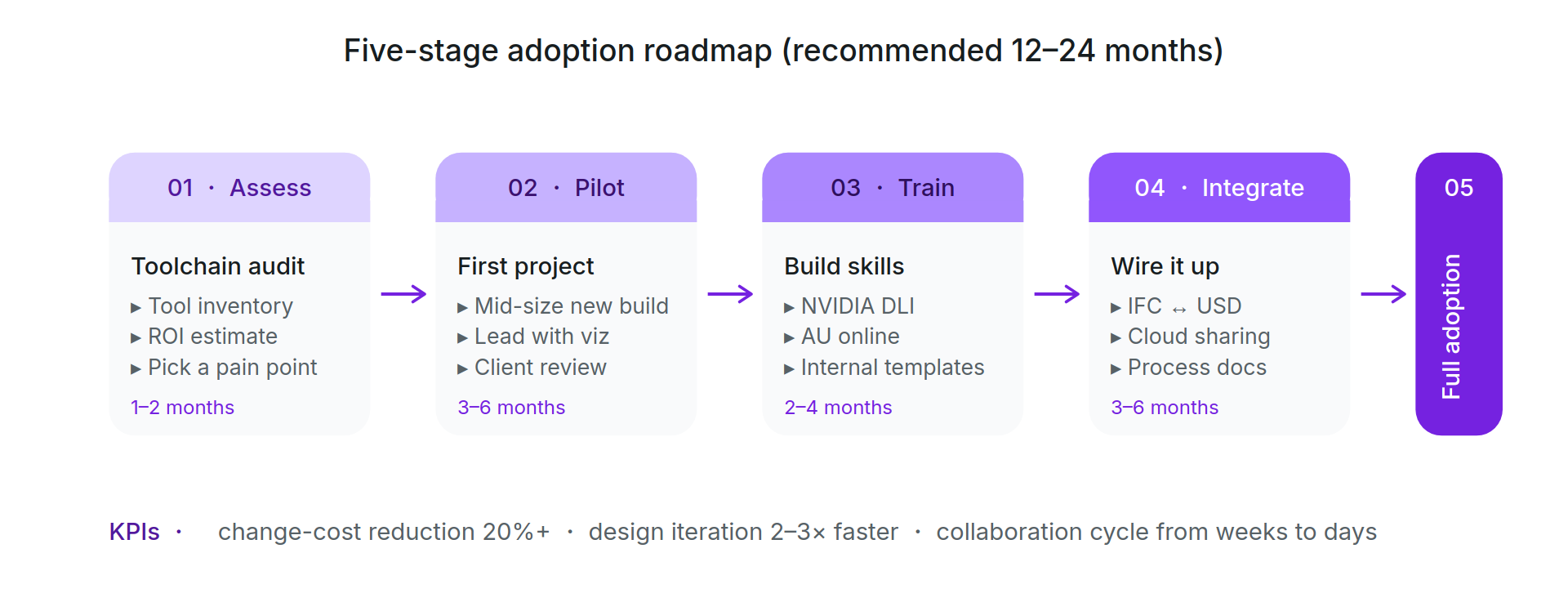
Figure 14 ・ OpenUSD AECO Five-Stage Adoption Roadmap
The ideal first pilot is the "design → visualization → client presentation" workflow on a mid-size new build — controllable risk, visible benefit. Second choice: facility planning. Avoid taking on facilities management (FM) or full-plant retrofit on the first try — data integration complexity is too high.
Four common adoption traps:
(1) assuming USD replaces IFC;
(2) skipping Layer / Variant planning, which leads to variants getting overwritten;
(3) converting an entire BIM model to USD without Payload partitioning, which crashes the workstation;
(4) pushing rollout without training — NVIDIA already offers an official OpenUSD Developer certification and a free Digital Twin Learning Path.